
Windows That Work Room by Room This August.

Kim Young • August 11, 2026

August in Surrey brings long, golden evenings and bright, sun-filled mornings, which means your windows are working harder than at almost any other time of year. But what suits a sun-drenched kitchen rarely suits a restful bedroom, and a living room needs a different balance again. Getting the details right, room by room, is where bespoke window dressings truly earn their keep.

Bright living room with large central window, cream curtains, and sunlight on hardwood floors.

Bedrooms: Prioritise Rest Over Everything Else.

A bedroom's job is simple; Help you sleep well, whatever the season is doing outside. In high summer, that means taking blackout window dressings seriously, especially with sunrise creeping earlier in south and east-facing rooms.

● Blackout linings behind curtains keep the room feeling soft and layered while blocking early light completely.
● A blackout Roman blind on its own suits smaller bedrooms or those with limited wall space either side of the window.
● Lightweight voiles paired with a blind let you enjoy a breeze on warm nights without sacrificing privacy.

We recently fitted a Camberley bedroom with interlined linen curtains in a soft dove grey, backed with full blackout lining. The client wanted something that still felt breathable in summer rather than heavy; Interlining gives that structure and light-blocking performance without the room feeling stuffy.

Cozy bedroom with a bed, bedside table, and a window framed by gray curtains.

A Note on Fabric Weight.

Summer doesn't mean abandoning heavier fabrics in bedrooms, it means choosing them thoughtfully. A mid-weight linen or cotton union still hangs beautifully and regulates temperature far better than a flimsy sheer, which offers little privacy or insulation come winter.

Living Rooms: Balance Light Control With Comfort.

Living rooms tend to see the most daylight variation across a single day, so flexibility matters more here than almost anywhere else in the house.

Layering remains our most popular solution for this room, a fitted blind for precise light control during bright afternoons, paired with full-length curtains for evening warmth and acoustic softness. This month, one of our clients based in Fleet, chose a woven neutral Roman blind beneath heavier linen-cotton curtains in a warm terracotta tone, giving the room a lovely late-summer richness without feeling overly formal.

Cozy living room with beige sofas, wood coffee table, and warm orange curtains by large windows

A few living room considerations:

● South or west-facing rooms benefit from a lined blind to reduce glare on television screens and protect furniture from fading.
● Bay windows often look their best with curtains that follow the angles individually, rather than one continuous track, it gives a far more tailored finish.
● Wide sliding or bifold doors onto a garden usually suit a slim wave-header curtain, which stacks back neatly and keeps sightlines clear for entertaining outdoors this month.

Kitchens: Practical First, Beautiful Second.

Kitchens have their own demands, steam, splashes, and often direct morning sun over the sink or hob. Fabric practicality matters as much as style here.

Roman blinds and roller blinds remain the most sensible choice for most kitchen windows, particularly above a sink or worktop where trailing fabric simply isn't practical. Wipeable, water-resistant fabrics are worth considering for splash zones, while a crisp cotton or linen-look blind suits open-plan kitchen-diners beautifully.

One of our Farnham clients, who has a large kitchen extension, chose café-style curtains for the upper portion of her window only, enough to soften the space and add privacy in the evenings, while keeping the sill free for herbs and morning light streaming in unobstructed.

Bright white kitchen with a sunlit window, beige curtains, and pale countertops.

For Kitchen-Diners.

Where a kitchen flows into a dining or seating area, it's often worth treating the window differently depending on which "zone" it sits in. A blind near the cooking area, and perhaps a softer curtain over French doors leading to the garden, lets each part of the room feel considered rather than uniform.

One House, Several Approaches.

The most successful homes rarely use the same window treatment throughout. Bedrooms call for rest and darkness, living rooms for flexibility and warmth, kitchens for practicality and each deserves fabric, fittings and finishing chosen specifically for that purpose.

At Poppy Love, every curtain and blind is handmade and measured individually for its window, whatever room it's destined for. Book a home consultation and we'll help you choose the right approach, room by room, for a home across Camberley, Surrey, Hampshire or Berkshire that feels beautifully considered from top to bottom.
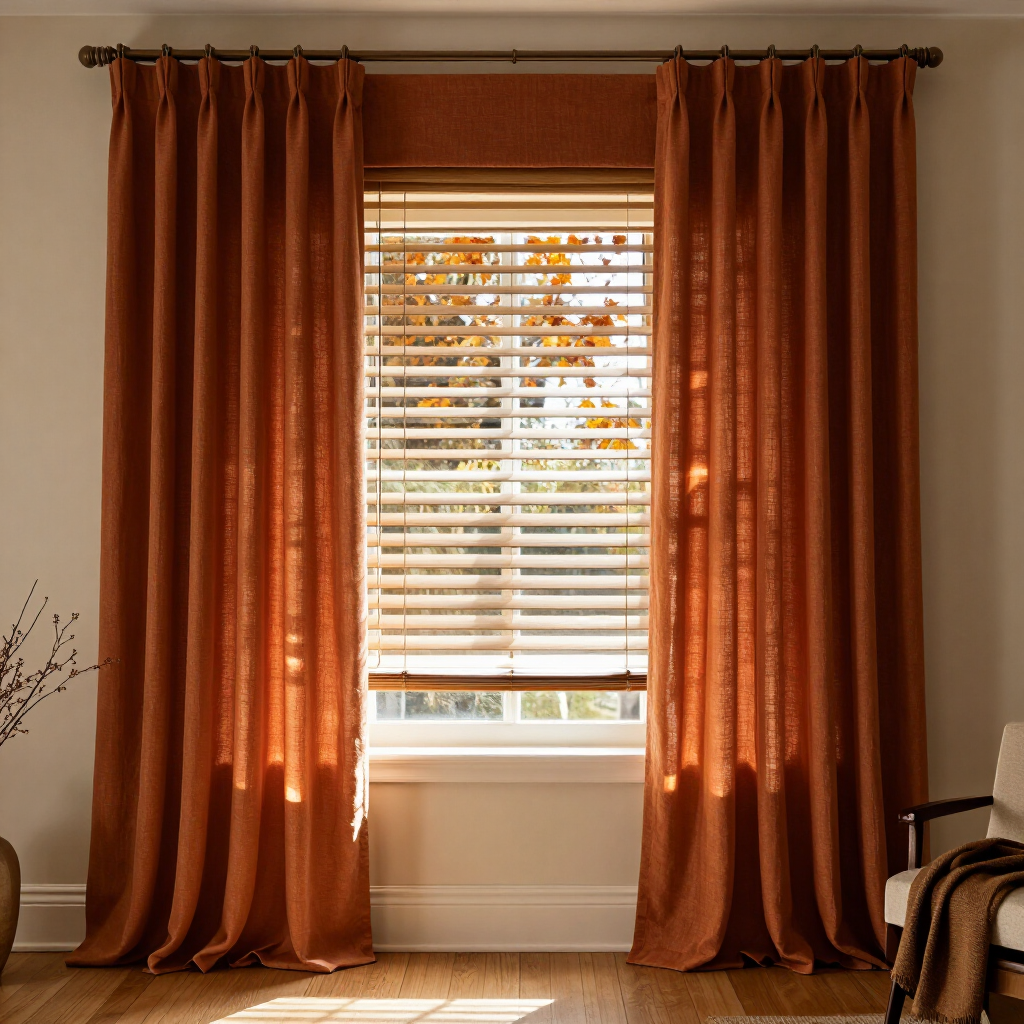
Rust-colored curtains framing a window with white blinds and autumn trees outside
By Kim Young • October 14, 2026
As the evenings draw in and the trees change to copper and gold, our thoughts naturally turn to making our homes feel warmer and more enveloping. One of the most effective ways to do this is through layering your window dressings, combining curtains, blinds and pelmets to create depth, richness and a sense of occasion that a single treatment simply can't achieve. Why Layer for Autumn? A layered window isn't just about looks; it's about function too. Autumn brings cooler mornings, unpredictable light and draughtier evenings, and layering gives you far greater control over all three. Warmth: an extra layer of fabric traps air and reduces heat loss through glass. Light control: a blind can filter low autumn sun without sacrificing privacy. Visual richness: combining textures adds a tailored, finished look no single curtain or blind can match. For period homes across Farnham, Odiham and Hartley Wintney, layering also respects the architecture; dressing a window properly, the way it was originally intended to be dressed. Starting with the Base Layer: Blinds. The foundation of a beautifully layered window is usually a well-fitted blind. A Roman blind in a warm wool-mix or textured linen sits neatly within the recess, offering precise control of light and privacy day to day. Choose tonal, muted shades this season. Rust, ochre, moss and deep terracotta all work beautifully against the low golden light of autumn afternoons. A recent client in Fleet chose a soft burnt-orange herringbone Roman blind for her study, which now glows beautifully whenever the afternoon sun streams through. Adding Curtains for Depth and Drama. Once the blind is in place, curtains bring softness, movement and a sense of luxury. Full-length, interlined curtains in a heavier fabric, think brushed cotton, wool blends or a lush velvet. These fabrics add real substance to a room as the temperatures drop. Fabric ideas for autumn curtains: Deep-pile velvet in aubergine, bottle green or burnt sienna Textured wool or bouclé for a tactile, cosy finish Warm-toned linen union for a softer, more relaxed layer Interlining is particularly worth considering this time of year. It doesn't just improve the drape and weight of a curtain, it also adds an extra thermal barrier against chilly window glass. The Finishing Touch: Pelmets. A pelmet is the detail that elevates a layered window from lovely to truly polished. It conceals the curtain heading and blind mechanism, creates a clean line across the top of the window, and adds an architectural finish that feels bespoke rather than off-the-peg. For a Camberley client with tall Victorian sash windows, we designed a box pelmet upholstered in a deep forest-green wool, edged with a subtle contrast braid. Paired with ivory Roman blinds and curtains in a complementary check, the result felt considered, warm and entirely tailored to the room. Pelmets work particularly well where: You want to hide curtain poles or blind headrails for a neater finish The window is a focal point deserving of extra detail You're working with high ceilings that benefit from a strong horizontal line Coordinating Without Overcomplicating. Layering doesn't mean everything needs to match exactly. In fact, the most elegant schemes rely on subtle contrast. Pair a plain blind with a patterned curtain, or a bold pelmet fabric with simpler curtains beneath. The key is choosing colours from the same palette so each layer feels connected rather than competing. A good rule of thumb: pick one dominant tone, one supporting neutral, and one textural accent, then let each window dressing take on a different role within that palette. Why Layering Suits Bespoke Homes. Layered window dressings are rarely off-the-shelf. Getting the proportions, headings and finishes right so the blind sits neatly behind the curtain, and the pelmet is scaled correctly to the window; This takes careful measuring and a practised eye. This is exactly where a bespoke, handmade approach makes all the difference, rather than relying on standard sizes that rarely fit period or characterful windows precisely. Ready to Layer Your Windows for Autumn? Layering curtains, blinds and pelmets is one of the most rewarding ways to bring warmth, texture and craftsmanship into your home this autumn. At Poppy Love, every layer is handmade and made-to-measure, designed to work together beautifully in homes across Camberley, Surrey, Hampshire and Berkshire. Book a home consultation and let's explore how layered window dressings could transform your rooms this season.
By Poppy Love • September 16, 2026
As September settles in and Surrey gardens turn from green to gold, many of our clients feel the pull towards richer, more layered interiors. Here's how to mix patterns with confidence this autumn.
More Posts